Execute the change management plan: monitor it, then adjust it
 · Published on
·Updated on ·8 min read
· Published on
·Updated on ·8 min read

Sommaire8 sections
- 01What does the ACMP Standard mean by executing the plan?
- 02What are the eight executions inside 5.4.1?
- 03Which signals should you watch while the plan runs?
- 04How do you manage the people side during execution?
- 05When and how should you modify the plans?
- 06How does execution connect to measuring adoption?
- 07What goes wrong during execution, and what does the exam expect?
- 08Frequently asked questions
This site follows Leanova Academy, an official ACMP® QEP™, and this article explains group 5.4 of the ACMP Standard for Change Management, second edition (2025): how a change management plan is carried out, watched and corrected once the work is live.
Group 5.4 has only two processes, but they hold most of the day-to-day work of a practitioner. If you have not yet read how the plan is built and approved, start with the article on group 5.3, then come back here for the execution side.
What does the ACMP Standard mean by executing the plan?
It means putting the approved plans into action while monitoring, measuring and controlling delivery against the baseline, as the purpose statement of 5.4 puts it.
The Standard describes the group as managing people, namely stakeholders and sponsors, and other resources, while building employee competence through learning and knowledge transfer. It also says execution involves checking that the work still serves the strategic objectives, spotting and reducing risks, and changing the plan when that is needed. In short, execution is not “doing the tasks on the list”. It is a loop of acting, observing and adjusting, and the Standard builds the observing and adjusting into the group itself.
What are the eight executions inside 5.4.1?
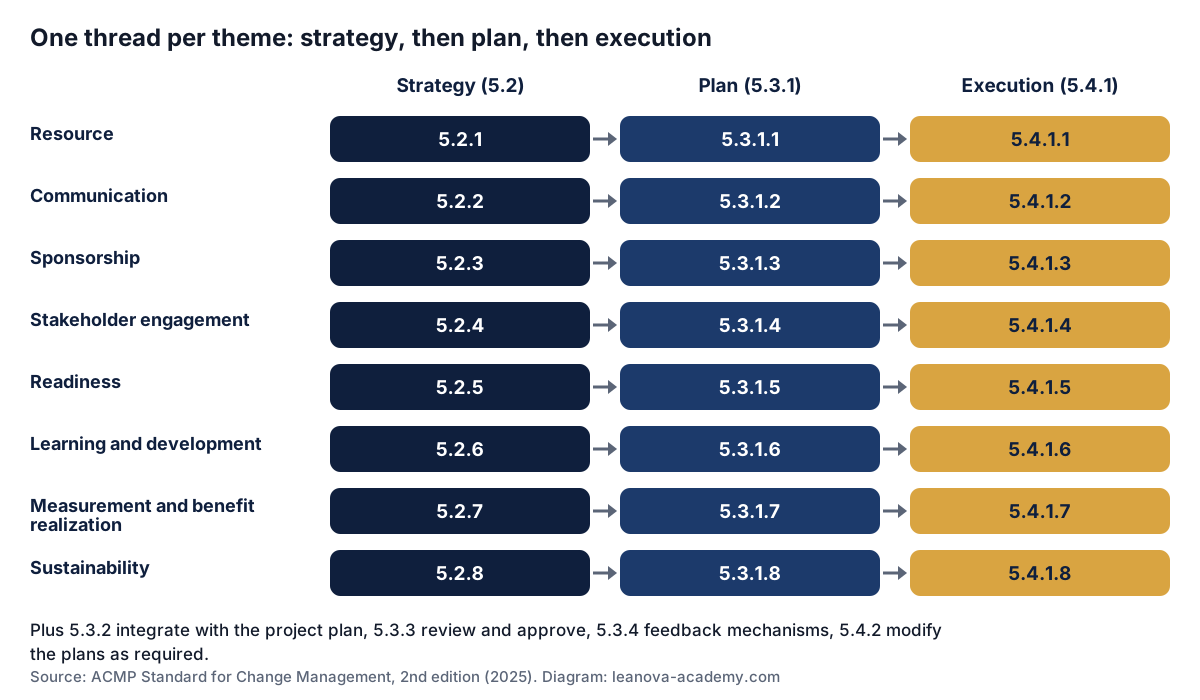
Process 5.4.1 contains eight sub-processes, 5.4.1.1 to 5.4.1.8, each executing one of the eight plans and each naming its own outputs.
The diagram below follows the eight threads from strategy through plan into execution, so you can see that every plan from group 5.3 has an execution counterpart. The table lists what each execution does and which outputs the Standard names.
| Section | Execution | What it watches or delivers | Named outputs |
|---|---|---|---|
| 5.4.1.1 | Execute the Resource Plan | Budget control, staffing conflicts, information handling, facilities and suppliers | Financial, Human, Information and Physical Resources Reports |
| 5.4.1.2 | Execute the Communication Plan | Timely, clear messages by the right method, with feedback channels running | Communication Activities |
| 5.4.1.3 | Execute the Sponsorship Plan | Preparing sponsors and keeping them engaged with regular status updates | Sponsor Activities; Sponsor Competency Building Activities |
| 5.4.1.4 | Execute the Stakeholder Engagement Plan | Engagement and resistance management with leaders and the change network | Stakeholder Engagement Activities; Sponsor Engagement Activities; Resistance Management Activities |
| 5.4.1.5 | Execute the Readiness Plan | Continuous monitoring of readiness criteria, with corrective action | Readiness Activities; Readiness Report |
| 5.4.1.6 | Execute the Learning and Development Plan | Materials, logistics, delivery and evaluation of learning | Learning and Development Activities; Learning and Development Reports |
| 5.4.1.7 | Execute the Measurement and Benefit Realization Plan | Tracking adoption, preparedness, outcomes and benefits against baselines | Measurement and Benefit Realization Activities; Reports |
| 5.4.1.8 | Execute the Sustainability Plan | Mechanisms that stop people sliding back to the old way | Sustainability Activities |
Note the shape of the outputs. Seven of the eight executions produce activities, and four produce reports. Reports are what a steering group reads, so a practitioner who runs activities without producing the matching reports leaves the monitoring half of the group undone.
Which signals should you watch while the plan runs?
Watch evidence that matches each plan: spend against budget, resource conflicts, awareness of the change, readiness criteria, learning results, adoption and the early warning signs of resistance.
The Standard gives concrete pointers. For resources, it expects spending to be controlled and regularly reported to senior stakeholders, and it warns that shortages of people can delay or erode benefits. For progress, it mentions testing stakeholder awareness and tracking staff turnover, absences and tardiness by stakeholder segment. For learning, it separates tangible indicators (what people know and can do, how they perform, output, speed of response, service levels, and how often they ask for help) from intangible ones (communication, quality of decisions, teamwork, job satisfaction, stress).
A fictional example makes this concrete. At Northgate Health, a regional hospital group moving to new rota software, the change lead reads a weekly dashboard with four lines: attendance at the two training waves, number of help requests from each ward, the share of shifts booked in the new tool, and absence rates on the pilot wards. In week three the help requests double on one ward while bookings stay flat. The lead does not wait for the monthly report: she talks to the ward’s change network, finds that the quick reference guide describes a screen that was renamed, and corrects the guide that week.
That last point is the reason networks of local change contacts matter. The Leanova Academy blog looks at how to keep them going in building change champion networks that survive month three.
How do you manage the people side during execution?
Prepare sponsors, keep them updated, and tackle resistance through leaders, the change network and supporting functions, not through the change team alone.
The Standard devotes real space to sponsors. In 5.4.1.3 the change team reviews the sponsor’s role with each leader and helps them understand their responsibilities and the visible actions that support the change, including prepared messages for stakeholder groups. The change lead then updates the sponsor regularly. In 5.4.1.4, resistance management is described as a task for several leaders, with job roles, performance management, learning needs and organizational development reviewed throughout. The practical reading is that resistance is rarely solved by a better slide deck; it is more often solved by a manager changing how work is assigned or assessed.
When and how should you modify the plans?
Whenever evidence shows that objectives are drifting or conditions change, through controlled procedures that fit your organization’s change control framework, then tell everyone affected.
Process 5.4.2 asks for an adaptive approach across the lifecycle. Leaders review objectives and adjust to keep momentum: they may add, remove or realign elements of the change program, slow it down or speed it up in response to pressure from inside or outside the organization. Two rules stand out. Changes to deliverables follow formal procedures, and once a modification to the plans or the strategies is approved, the decision is communicated to every relevant stakeholder. The output is the set of updated change management plans.
The loop closes upstream too. Feedback built in 5.3.4 supplies the data, the plans are updated, and the project plan may need to follow. Treat each modification as a versioned decision: what changed, why, who approved it, and who was told.
How does execution connect to measuring adoption?
Execution produces the measurements that show whether people have adopted the change, whether organizational outcomes followed, and whether the business case benefits are appearing.
Section 5.4.1.7 describes a chain: adoption is the first step, then organizational outcomes such as better customer experience or efficiency, then the benefits in the business case, such as cost savings or sales. It recommends involving the affected business unit in agreeing the measurements, which also helps hand over the accountability for reporting once the practitioner leaves. Honest, frequent status reports from the change lead (progress, obstacles, barriers) feed the decisions of the stakeholder committee on whether to adjust course. Measurement does not stop when delivery ends; what happens after is covered in the article on closing the change management effort.
What goes wrong during execution, and what does the exam expect?
Typical failures are measuring activity instead of change, ignoring spending and staffing conflicts, and modifying plans informally; the exam expects you to reason about the processes by their purpose.
- Counting outputs: sessions held and emails sent say little about adoption.
- Silent drift: a plan changed in a corridor conversation leaves the baseline, the sponsor and the project plan out of step.
- One-way messages: a communication plan with no working feedback channel cannot show what people think.
- Stopping at go-live: 5.4.1.8 is there to prevent a return to the old way.
For the bigger picture, the overview of the Standard places this group among the five. The ACMP has used the second edition for the CCMP exam since 1 April 2026 and does not publish a weighting per group, so no percentage can be quoted for 5.4. A good study habit is to take a scenario and ask which of the eight executions it belongs to, then whether 5.4.2 applies. The full list of 33 processes and their outputs helps with the vocabulary, and the self-paced CCMP course from Leanova Academy offers the 21 hours of QEP training the ACMP requires. The Standard itself is obtained from the ACMP.
Frequently asked questions
How many processes are in group 5.4?
Two at the second level: 5.4.1 executes, manages and monitors the comprehensive plan, and 5.4.2 modifies the plans. The first has eight sub-processes, one per component plan.
Is executing the plan the same as monitoring it?
No, but they are linked. The title of 5.4.1 includes execute, manage and monitor, and the purpose of the group is to monitor, measure and control delivery against the baseline plans.
Can I change an approved plan?
Yes. Process 5.4.2 expects adaptation, as long as changes follow formal control procedures and the decision is shared with the people it affects.
Who reports on progress during execution?
The Standard assigns frequent, honest status reporting to the change management lead, covering progress, impediments and potential barriers, addressed to sponsors and project leads.
Does execution end at go-live?
No. The sustainability execution in 5.4.1.8 exists to keep the change from reverting, and measurement of adoption and benefits can extend beyond delivery.
Was this article helpful?
Be the first to rate this article.
Summarise this article with:
Share: