ACMP Standard processes and deliverables: a checklist to adapt
 · Published on
·Updated on ·9 min read
· Published on
·Updated on ·9 min read

Sommaire5 sections
What does the ACMP Standard give you for each process?
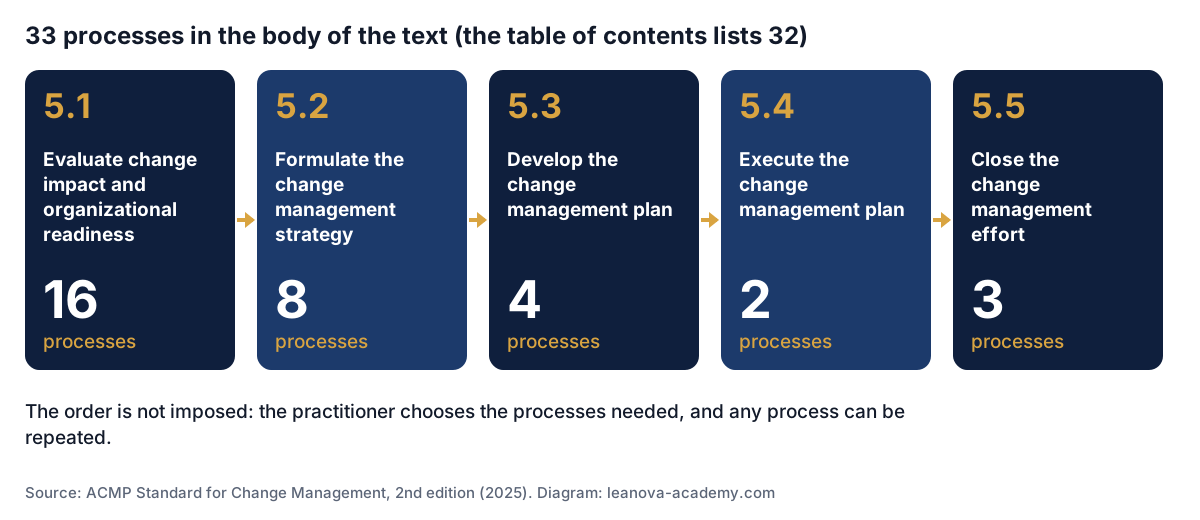
For each of its 33 second-level processes, the Standard states a purpose, explains the focus, and ends with a small table of common inputs and outputs, and the outputs are the named deliverables you can tick off.
This site follows Leanova Academy, an official ACMP® QEP™, and this page turns section 5 of the ACMP Standard for Change Management, second edition (2025), into a working checklist. The diagram above shows the five process groups that hold the 33 processes. For the wider picture of the document, start with our overview of the ACMP Standard; the Standard itself is obtained from the ACMP, whose Standard page is the authority.
Two cautions from the Standard shape everything below. Its input and output tables are described as common examples, not exhaustive lists, and inputs and outputs do not pair up one to one. Also, the document says it does not mandate particular activities, which is why you will not find the word “shall” in it. A checklist built from it is therefore a menu to select from, not an audit form.
The checklist: 33 processes, group by group
The 33 processes split 16, 8, 4, 2 and 3 across the five groups, and the tables below follow the body of the Standard, section 5.1 to 5.5.
5.1 Evaluate Change Impact and Organizational Readiness (16 processes)
This group assesses the change, the people and the organization before any strategy is written, and the Standard asks for this evaluation to begin before strategies and plans are formulated. Our article on group 5.1 goes through the 16 processes one by one.
| No. | Process | Outputs named in the Standard |
|---|---|---|
| 5.1.1 | Define the Change | Change Definition; Project Charter (Updated) |
| 5.1.2 | Determine Why the Change is Required | Business Case (Updated); Project Charter (Updated); Case for Change |
| 5.1.3 | Develop a Vision of the Future State | Vision Statement |
| 5.1.4 | Determine Change Management Roles and Responsibilities | Change Management Roles and Responsibilities; Change Management Governance |
| 5.1.5 | Identify Goals, Objectives, and Success Criteria | Change Goals and Objectives; Criteria and Measures for Change Success, and future-state Benefits |
| 5.1.6 | Identify Sponsors Accountable for the Change | Sponsor Identification; Sponsor Assessment |
| 5.1.7 | Identify Stakeholders Affected by the Change | Stakeholder Analysis |
| 5.1.8 | Conduct the Change Impact Assessment | Change Impact Assessment |
| 5.1.9 | Assess Alignment of the Change with Organizational Strategic Objectives and Performance Measurement | Organizational Alignment Assessment |
| 5.1.10 | Assess External Factors that May Affect Organizational Change | External Environment Impact Assessment |
| 5.1.11 | Assess Organizational Culture(s) Related to the Change | Culture Assessment |
| 5.1.12 | Assess Organizational Capacity for Change | Organizational Change Capacity Assessment; Competency Assessment |
| 5.1.13 | Assess Organizational Readiness for Change | Organizational Change Readiness Assessment |
| 5.1.14 | Assess Communication Needs and Channels | Communication Needs Assessment |
| 5.1.15 | Assess Learning Capabilities | Learning Needs Assessment |
| 5.1.16 | Conduct Change Risks Assessment | Change Risks Assessment |
5.2 Formulate the Change Management Strategy (8 processes)
Each of the eight strategies takes earlier assessments as inputs and produces one named strategy document; the 5.1 outputs feed them directly. See the article on the eight strategies for how they connect.
| No. | Process | Outputs named in the Standard |
|---|---|---|
| 5.2.1 | Develop the Resource Strategy | Resource Strategy |
| 5.2.2 | Develop the Communication Strategy | Communication Strategy |
| 5.2.3 | Develop the Sponsorship Strategy | Sponsorship Strategy |
| 5.2.4 | Develop the Stakeholder Engagement Strategy | Stakeholder Engagement Strategy |
| 5.2.5 | Develop the Readiness Strategy | Readiness Strategy |
| 5.2.6 | Develop the Learning and Development Strategy | Learning and Development Strategy |
| 5.2.7 | Develop the Measurement and Benefit Realization Strategy | Measurement and Benefit Realization Strategy; Revised Performance and Rewards Targets (Updated) |
| 5.2.8 | Develop the Sustainability Strategy | Sustainability Strategy |
5.3 Develop the Change Management Plan (4 processes)
The first process produces the eight plans that mirror the eight strategies, and the next three integrate them with the project plan, get them approved and set up feedback. The article on group 5.3 covers the detail.
| No. | Process | Outputs named in the Standard |
|---|---|---|
| 5.3.1 | Develop a Comprehensive Change Management Plan | Eight plans, one per sub-process 5.3.1.1 to 5.3.1.8: Resource Plan; Communication Plan; Sponsorship Plan; Stakeholder Engagement Plan; Readiness Plan; Learning and Development Plan; Measurement and Benefit Realization Plan; Sustainability Plan |
| 5.3.2 | Integrate the Change Management and Project Plans | Change Management Plans (Updated); Project Plan (Updated) |
| 5.3.3 | Review and Approve the Change Management Plans in Collaboration with Project Leadership | Change Management Plans (Approved) |
| 5.3.4 | Develop Feedback Mechanisms to Monitor Performance to Plan | Communication Plan (Updated); Stakeholder Engagement Plan (Updated); Learning and Development Plan (Updated); Measurement and Benefit Realization Plan (Updated) |
5.4 Execute the Change Management Plan (2 processes)
Execution mirrors planning: one process runs the eight plans and reports on them, another changes them when reality moves. Read the article on group 5.4 for the signals to watch.
| No. | Process | Outputs named in the Standard |
|---|---|---|
| 5.4.1 | Execute, Manage, and Monitor Implementation of the Comprehensive Change Management Plan | Per sub-process 5.4.1.1 to 5.4.1.8: Financial Resources Report, Human Resources Report, Information Resources Report, Physical Resources Report; Communication Activities; Sponsor Activities, Sponsor Competency Building Activities; Stakeholder Engagement Activities, Sponsor Engagement Activities, Resistance Management Activities; Readiness Activities, Readiness Report; Learning and Development Activities, Learning and Development Reports; Measurement and Benefit Realization Activities, Measurement and Benefit Realization Reports; Sustainability Activities |
| 5.4.2 | Modify the Change Management Plans as Required | Change Management Plans (updated) |
5.5 Close the Change Management Effort (3 processes)
Closure compares results with objectives, captures lessons and hands the outcome to its operational owners; the article on group 5.5 explains each step.
| No. | Process | Outputs named in the Standard |
|---|---|---|
| 5.5.1 | Evaluate the Change Outcome Against the Objectives | Change Outcome Evaluation Report |
| 5.5.2 | Design and Conduct Lessons Learned Evaluation | Lessons Learned Evaluation Document; Remediation Plan |
| 5.5.3 | Gain Approval for Closure, Transfer of Ownership, and Release of Resources | Final Summary Report; Change Initiative Closure; Agreement on Transfer of Ownership |
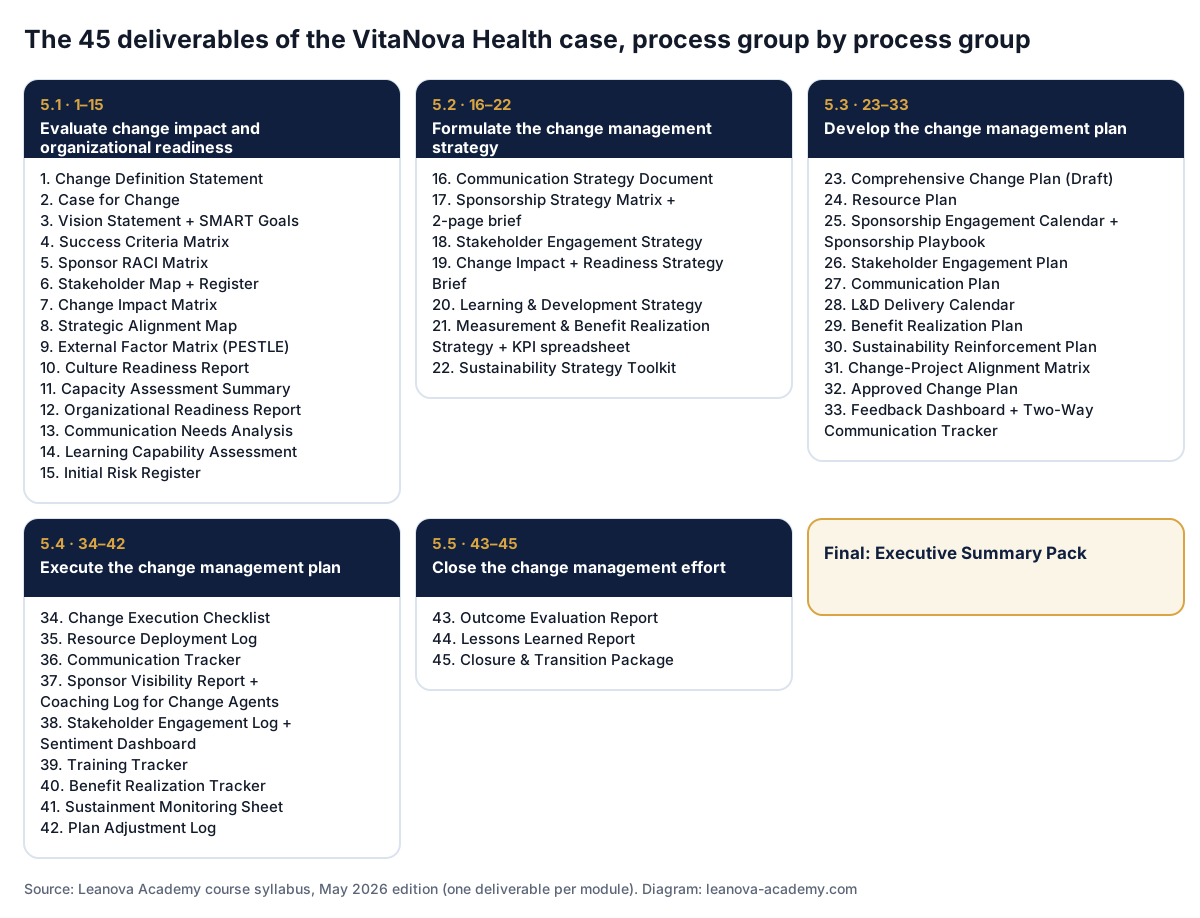
The Leanova CCMP course turns this checklist into practice: its case study, VitaNova Health, produces one deliverable per module, 45 in all, sorted below by process group.
How do you use the Standard as a project checklist?
Use it as a menu: for each of the 33 processes, decide whether it applies, what you already hold that serves as its output, and how much depth the change deserves.
The Standard says processes need not run in a fixed order, that any of them may be repeated, and that the practitioner picks the ones required. Level of detail should reflect the complexity and risk of the change. A practical pass looks like this:
- List the 33 numbers in a sheet, one row each, with the output name beside it.
- Mark every row as needed now, already covered, deferred or not applicable, and write one line of reason.
- For rows marked needed, name an owner and a due date, and note which earlier output it depends on.
- Revisit the sheet at each stage gate, since the Standard suggests revisiting some assessments as you learn more about the change.
A fictional example. A regional hospital group is replacing two admissions systems. The change lead marks 5.1.10 (external factors) as light, since regulation is stable, but 5.1.12 (capacity) and 5.1.16 (risks) as heavy, because three other projects are landing on the same wards. Rows 5.4.1.8 and 5.5.3 are deferred, with a date. The sheet shows in one glance what was skipped on purpose and what was simply forgotten.
| Status | Meaning | What to record |
|---|---|---|
| Needed now | The output does not exist and the change needs it | Owner, due date, upstream outputs it uses |
| Already covered | An existing document does the job under another name | Name and location of that document |
| Deferred | Useful later, such as sustainability or closure items | Trigger or date for the review |
| Not applicable | The change does not call for it | One-line reason, to protect you from later questions |
Learners often ask how this connects to the exam. The CCMP exam is based on the second edition from 1 April 2026, and a candidate gains most by understanding why each output feeds the next process rather than memorising names. Our self-paced CCMP exam prep course is a 21-hour QEP course priced at US$595 on 7 October 2026. For a practitioner angle on which documents repay the effort, see Leanova’s blog post on change management deliverables that earn their keep. To see how this checklist maps onto the exam’s subject view, read the guide to the Annex B subject groups.
Why does the contents page list 32 processes when the text has 33?
Because the contents page of the second edition shows only three processes under 5.3, while the body of the text and Annex B contain four.
The contents page omits “Integrate the Change Management and Project Plans” and then numbers the review process 5.3.2 and the feedback process 5.3.3. In the body, integration is 5.3.2, review and approval is 5.3.3 and feedback mechanisms are 5.3.4. This article follows the body, because Annex B uses the same numbers. If you cite a number from the Standard in a plan or a study note, check it against the body and not the contents page.
Counting also depends on level. Beneath the 33 second-level processes sit 22 third-level sub-processes: eight plans, eight executions, three for lessons learned and three for closure. That is why a checklist can reasonably have 33 rows or 55, and why you should say which level you mean.
To check your own project against the 33 processes, use our free ACMP Standard project self-check: it scores each process group and lists the deliverables still missing.
Frequently asked questions
How many processes does the ACMP Standard contain?
The body of the second edition has 33 second-level processes: 16 in group 5.1, 8 in 5.2, 4 in 5.3, 2 in 5.4 and 3 in 5.5. The contents page lists 32 because it omits one 5.3 process.
Do I have to produce every deliverable?
No. The Standard describes generally accepted practice and does not mandate particular activities. Processes may be selected, reordered and repeated, so the checklist is a way to make deliberate choices.
Are inputs and outputs in the Standard complete?
No. The Standard presents them as commonly accepted examples and notes they do not match one to one. Your organization may use other names for equivalent documents, which is fine if you can show the equivalence.
Where can I get the Standard?
From the ACMP. Its Standard page is the place to start. It is a copyrighted publication, so this article paraphrases it and only repeats the official names of processes and deliverables.
Will the CCMP exam ask me to recite deliverable names?
The exam content outline is not given in the Standard, so we cannot say. What is known is that the exam covers the second edition from 1 April 2026; see the CCMP exam format article for the published format.
Was this article helpful?
Be the first to rate this article.
Summarise this article with:
Share: