Change management strategy: what the ACMP Standard makes you decide
 · Published on
·Updated on ·8 min read
· Published on
·Updated on ·8 min read

Sommaire8 sections
- 01What is the change management strategy in the ACMP Standard?
- 02What are the eight strategies?
- 03What do the inputs reveal about how the strategies connect?
- 04What does each strategy actually decide?
- 05How do the strategies become the eight plans?
- 06Which mistakes weaken a change strategy?
- 07How does this group connect to the CCMP exam?
- 08Frequently asked questions
What is the change management strategy in the ACMP Standard?
It is the overall approach for moving an organization from its current state to its future state, set out in section 5.2 as eight linked strategies that together say what will be done, why, by whom, when and with what expected outcome.
This site follows Leanova Academy, an official ACMP® QEP™, and this article reads group 5.2, Formulate the Change Management Strategy, in the ACMP Standard for Change Management, second edition (2025). The Standard is paraphrased, not reproduced, and you can obtain the full text through the ACMP Standard page.
According to the Standard, the strategy describes the scale, scope and complexity of the change program, along with options, constraints, success criteria, measurements, a RACI and governance for each activity. It also restates the Case for Change. Where the strategy gives the "why" and the "what", the plan of group 5.3 gives the "how", a split we follow in the article on the change management plan.
What are the eight strategies?
They are the Resource, Communication, Sponsorship, Stakeholder Engagement, Readiness, Learning and Development, Measurement and Benefit Realization, and Sustainability strategies, numbered 5.2.1 to 5.2.8.
The diagram below shows the eight as a wheel around the Case for Change, which is how the Standard treats them: separate documents, one shared rationale.
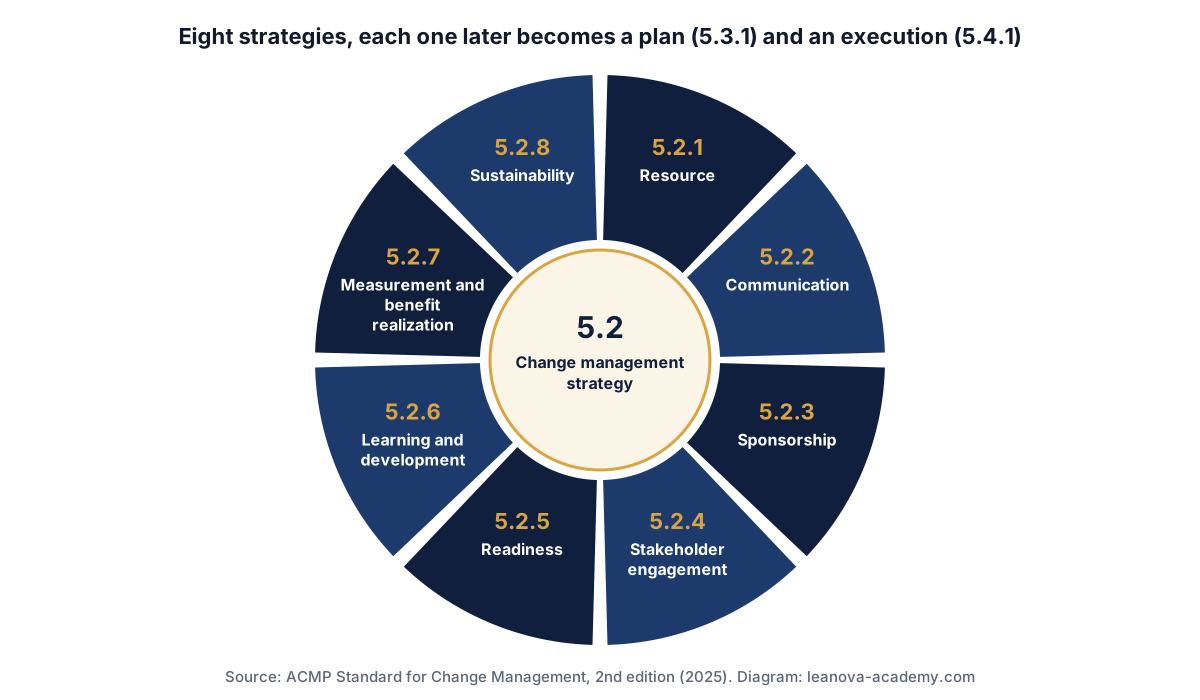
The table sets out what each strategy decides, the main inputs the Standard lists for it, and the plan it later becomes in 5.3.1.
| Strategy | What it decides | Main inputs named in the Standard | Becomes |
|---|---|---|---|
| 5.2.1 Resource | How financial, human, information and physical resources are identified, acquired and used, with a timeline tied to milestones | Roles and Responsibilities; Change Impact, Capacity, Communication Needs and Learning Needs Assessments | 5.3.1.1 Resource Plan |
| 5.2.2 Communication | Audiences, messages, channels, frequency, feedback loops and sign-off | Project Charter; Change Definition; Vision Statement; Stakeholder Analysis; Change Impact Assessment; current channels; readiness assessment | 5.3.1.2 Communication Plan |
| 5.2.3 Sponsorship | How sponsors are prepared and used to promote and drive adoption | Success criteria; Sponsor Assessment; Stakeholder Analysis; readiness and risk assessments | 5.3.1.3 Sponsorship Plan |
| 5.2.4 Stakeholder Engagement | Who must be engaged, how much, and how their input is sought | Stakeholder Analysis; Change Impact and Culture Assessments; Communication and Sponsorship Strategies; risks | 5.3.1.4 Stakeholder Engagement Plan |
| 5.2.5 Readiness | Readiness criteria, governance and accountability for what must be done before go-live | Change Impact and Readiness Assessments; Resource, Communication and Stakeholder Engagement Strategies | 5.3.1.5 Readiness Plan |
| 5.2.6 Learning and Development | Skills to build, who needs training, content, delivery method and evaluation | Stakeholder Analysis; Learning Needs Assessment; Communication and Stakeholder Engagement Strategies | 5.3.1.6 Learning and Development Plan |
| 5.2.7 Measurement and Benefit Realization | Success measures, owners, data collection, reporting and action on slippage | Project Charter; Sponsorship Strategy; Change Goals and Objectives; success criteria | 5.3.1.7 Measurement and Benefit Realization Plan |
| 5.2.8 Sustainability | How the change becomes normal operation, with metrics, ownership and continuous improvement | Business Case; Strategic Plan; goals; Sponsorship Strategy; External Environment and Change Risks Assessments | 5.3.1.8 Sustainability Plan |
What do the inputs reveal about how the strategies connect?
They show that the eight strategies lean on each other, so a sensible working order emerges even though the Standard imposes none.
The Stakeholder Engagement Strategy lists the Communication Strategy and the Sponsorship Strategy among its inputs. The Readiness Strategy takes the Resource, Communication and Stakeholder Engagement strategies. The Learning and Development Strategy takes the Communication and Stakeholder Engagement strategies, and Measurement takes the Sponsorship Strategy. In practice this means resource needs, communication and sponsorship tend to be drafted first, with engagement, readiness and learning following, and measurement and sustainability closing the set. The Standard's general rule still applies: processes need not be sequential, the practitioner picks those needed, and any can be repeated.
What does each strategy actually decide?
Each one turns an assessment into a choice, and the useful way to read them is by the decision they force.
Resource decides how much budget, people, information and facilities the change effort needs and when. It integrates five inputs, including the Change Impact Assessment and the capacity assessment, and it is meant to prevent bottlenecks through continuous monitoring.
Communication decides audiences, targeted messages, channels, frequency, feedback loops and the review process before anything is published. The Standard says successful communication of the Case for Change lets every stakeholder level say what is changing and how it affects them personally. Its principles call for messages that are simple, relevant and consistent.
Sponsorship decides how to prepare sponsors and close gaps in their commitment as early as possible. The Standard assigns the job to the Change Management Lead, with input from people who know the sponsors, and lists risks such as weak commitment, skill gaps and past sponsorship failures.
Stakeholder Engagement decides who needs what level of involvement. The Standard says it may not suit every effort, but in complex, large-scale changes an overall direction helps align plans, requirements and metrics.
Readiness decides the benchmarks that tell you the organization is prepared, along with who is accountable for reaching them before implementation. Learning and Development decides the skills gap, the audience, content and delivery method (instructor-led, computer-based, simulations, on-the-job and others), the timeline and how learning will be evaluated. It also says training should come close enough to the change for people to remember it.
Measurement and Benefit Realization decides what will be measured, by whom and how often, and what happens when attainment is slow. The Standard says to begin measuring as early as possible. Sustainability decides how the change is embedded: ongoing communication, metrics, performance management, rewards, learning, continued ownership and continuous improvement, with lessons learned from each phase as key input.
How do the strategies become the eight plans?
Each strategy is expanded in group 5.3 into a plan with the same theme, so the Resource Strategy becomes the Resource Plan in 5.3.1.1, and so on through the Sustainability Plan in 5.3.1.8.
The table above shows the pairs. The plans are where actions, timelines and resources are set. They are then integrated with the project plan (5.3.2) and approved with project leadership (5.3.3), covered in the article on the plan. When a strategy is vague, the plan inherits the vagueness, so test each strategy by asking whether someone could write a dated plan from it.
Before that point, the Standard requires the strategy, including its supporting strategies, to be validated and approved by the change sponsor and appropriate key stakeholder leadership. In complex programs the audience can include works councils or outside suppliers, and the review route should be defined in the governance documents.
Which mistakes weaken a change strategy?
Most come from writing it too early, too generically or too much in isolation.
- Starting without assessments. The strategy is meant to be tailored to the organization or parts of it; a template filled in from memory is not.
- Treating the eight as separate documents. Their inputs overlap on purpose, so changing one usually moves another.
- Starting with communication because it is visible. Messages need the sponsor and stakeholder picture behind them. Our blog guide to a change communication plan shows what to settle before drafting.
- Skipping approval. A strategy that the sponsor has not validated is a proposal, not a decision.
- Mixing strategy and plan. The strategy says why and what; dates, owners and tasks belong in the plan.
How does this group connect to the CCMP exam?
The CCMP exam is based on the second edition of the Standard from 1 April 2026, so the eight strategies are part of what candidates are expected to understand, though the Standard publishes no exam weighting.
The eligibility rules ask for 21 hours of training aligned with the Standard, and a QEP course such as the self-paced CCMP course at Leanova Academy is built for that. For revision, the guide to subject groups shows how the strategies appear in the Annex B domains, where Readiness sits under risk management. For the whole structure, see the overview of the Standard.
Frequently asked questions
How many strategies does the ACMP Standard describe?
Eight, in section 5.2: resource, communication, sponsorship, stakeholder engagement, readiness, learning and development, measurement and benefit realization, and sustainability.
Is a strategy the same as a plan?
No. In the Standard, the strategy provides the "why" and the "what"; the plan in group 5.3 provides the "how", with actions, timelines and resources.
Do I need all eight strategies on every change?
Not necessarily. The Standard says a Stakeholder Engagement Strategy may not suit every effort, and the practitioner chooses which processes the change needs.
Who approves the change management strategy?
The change sponsor and appropriate key stakeholder leadership must validate and approve it, and the review route should be defined in the program's governance documents.
Which 5.1 outputs does the strategy need?
Mainly the Change Impact Assessment, Stakeholder Analysis, Sponsor Assessment, capacity and readiness assessments, communication and learning needs assessments, and the risk assessment.
Was this article helpful?
Be the first to rate this article.
Summarise this article with:
Share: