ACMP Standard for Change Management: a plain-English guide to the 2025 edition
 · Published on
·Updated on ·11 min read
· Published on
·Updated on ·11 min read

Sommaire9 sections
- 01What is the ACMP Standard for Change Management?
- 02Who is the Standard written for?
- 03What changed in the second edition?
- 04How is the Standard organised?
- 05Why does the Standard treat change as a process?
- 06What are the five process groups?
- 07How do you use the Standard without turning it into a recipe?
- 08How does the Standard relate to the CCMP exam?
- 09Frequently asked questions
What is the ACMP Standard for Change Management?
It is the ACMP's reference description of how organisational change is professionally managed: shared terms, eight core concepts and a process model of five groups. The current text is the second edition, published in 2025, and it is the document the CCMP credential rests on.
This site follows Leanova Academy, an official ACMP® QEP™, and the Standard is the document every QEP course is built to align with. This guide explains what the Standard contains, who it is written for and how a practitioner can use it without treating it as a script. The wording below is a paraphrase of the ACMP Standard for Change Management, second edition (2025); the full text is available from the ACMP through its official Standard page, and that is the version to cite.
Who is the Standard written for?
For anyone who has to move an organisation from a current state to a future state, whether or not "change manager" is on their business card. Section 1 says it applies to public, private and community organisations and to any change, whatever its size, length, location or culture.
The introduction names two audiences. Individuals use it to build their practice and to have their skills recognised against an objective reference, and organisations use it to improve adoption and to judge skills when they hire or buy training. The foreword adds that it is also a resource for many professionals in any industry who drive change without being dedicated change specialists.
One limit matters for anyone reading a vendor's claims. The Standard's own disclaimer states that the ACMP does not certify, test or inspect organisations for compliance with it. The text is a set of voluntary guidelines, so a company cannot be "ACMP Standard certified"; what exists are individual credentials (CCMP®, MCMP™) and education providers qualified by the ACMP (QEP™). The difference between a course certificate and a credential is explained on this site in the certificate versus certification guide.
What changed in the second edition?
The foreword describes an adaptation, not a rewrite: core principles unchanged, the framework still neutral about methods, and updates aimed at usability and clarity, with extra emphasis on change readiness and on flexibility in the order of activities.
The adaptation is based on the most recent Job Task Analysis, a global survey of how change is practised today, which also underlies the exam specifications. More than 100 experienced CCMPs and QEPs gave over 1,500 volunteer hours to it. The first edition appeared in 2014 and, according to the foreword, brought together more than 1,100 change professionals from 57 countries. For the dated comparison, the effect on exam candidates and what is, and is not, documented about the 2014 text, read what changed between the 2014 and 2025 editions.
How is the Standard organised?
It has two parts. Part I is the Standard for Change Management itself, and Part II is the ACMP Change Management Code of Ethics, published in the same volume.
| Element | What it contains |
|---|---|
| Introduction, scope, normative references | Purpose, who can use it, and two referenced documents: the ACMP Statement of Change Management and ISO 21500:2012 on project management |
| Section 3, terms and definitions | 17 terms, from Adoption and Benefit to Sponsor, Sustainability and Vision |
| Section 4, concepts | Eight short sections, from "Change is a Process" (4.1) to "Change Readiness" (4.8) |
| Section 5, change management process | Five process groups containing 33 processes, each with inputs and outputs |
| Appendix A | The ACMP Statement of Change Management: definition, boundaries and 16 areas of knowledge |
| Appendix B | The processes mapped to nine subject groups |
| Part II | The Code of Ethics: five duties and a complaint procedure |
The definitions in section 3 are short and worth learning as written, because exam questions and project documents depend on them. Three are often confused: a stakeholder is an individual affected by a change, a sponsor is the individual or group accountable for realising its benefits, and readiness is how prepared the organisation, or part of it, is to accept and absorb what is coming. The change management glossary on this site sets other common terms next to them.
Why does the Standard treat change as a process?
Because, according to concept 4.1, change is not a single event but a transition made of many events that carry people from the current state to the future state. A project go-live is one event inside that transition, and adoption comes later and needs deliberate work.
The diagram below shows the idea behind the Standard's own figure for 4.1, redrawn for this guide. Performance usually dips during a transition, and the dip can happen at several moments before the future state is reached. Without change management, the Standard says, adoption can fail and old behaviours return. With it, the Standard says, adoption and benefits realisation become more likely.
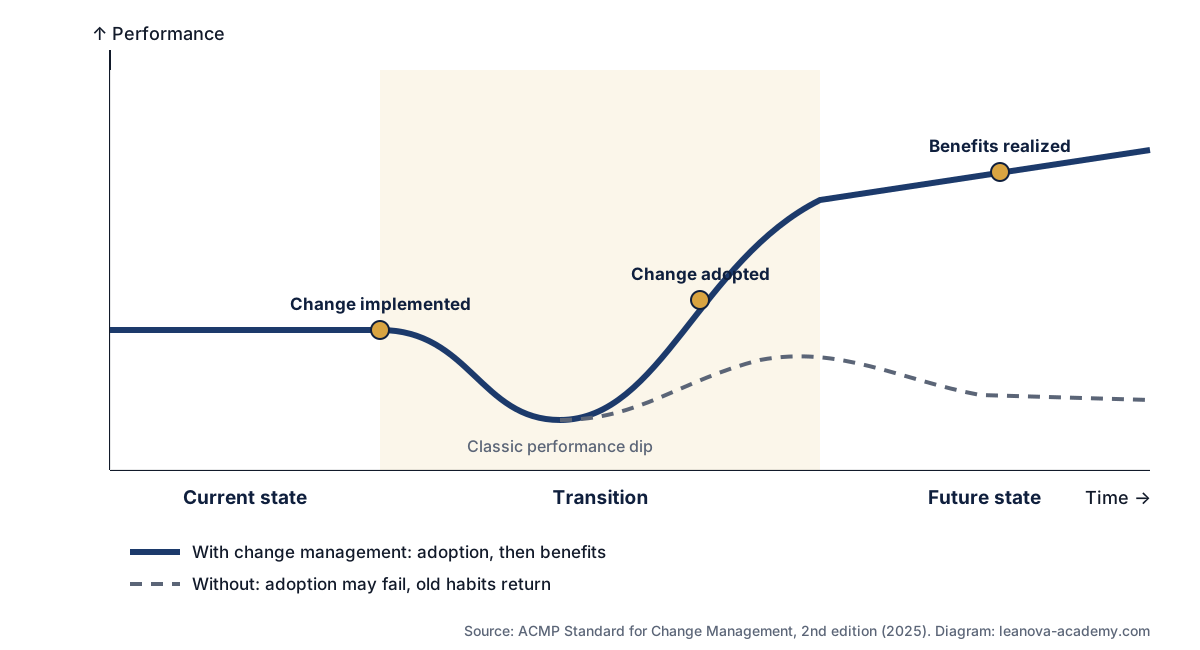
The same section lists what change management can do: raise readiness and adaptability, strengthen engagement, limit the performance drop, speed up proficiency with the new way of working, and sustain the result once the future state has been reached. Sections 4.2 to 4.8 add the supporting concepts:
- the link between strategic planning, the vision and the change (4.2);
- the variables that define a type of change, and the fact that scale should follow analysis (4.3);
- how project management and change management complement each other (4.4);
- the organisational and the individual level of change (4.5);
- roles, from the change management lead to sponsors, change leaders and change agents (4.6);
- organisational alignment (4.7);
- change readiness (4.8).
What are the five process groups?
They are Evaluate Change Impact and Organizational Readiness (5.1), Formulate the Change Management Strategy (5.2), Develop the Change Management Plan (5.3), Execute the Change Management Plan (5.4) and Close the Change Management Effort (5.5). The output of one process becomes the input of another, which is why they are called linked groups.
| Group | Processes | The question it answers |
|---|---|---|
| 5.1 Evaluate Change Impact and Organizational Readiness | 16 | What is the change, who does it affect, and how ready, able and loaded are they? |
| 5.2 Formulate the Change Management Strategy | 8 strategies | What high-level approach will carry the change? |
| 5.3 Develop the Change Management Plan | 4 | What exactly will be done, and how does it fit the project plan? |
| 5.4 Execute the Change Management Plan | 2 | Is the plan being carried out, and does it need changing? |
| 5.5 Close the Change Management Effort | 3 | Did the change achieve its objectives, what was learned, and who owns it now? |
The diagram below places the five groups side by side, as a summary of this table.
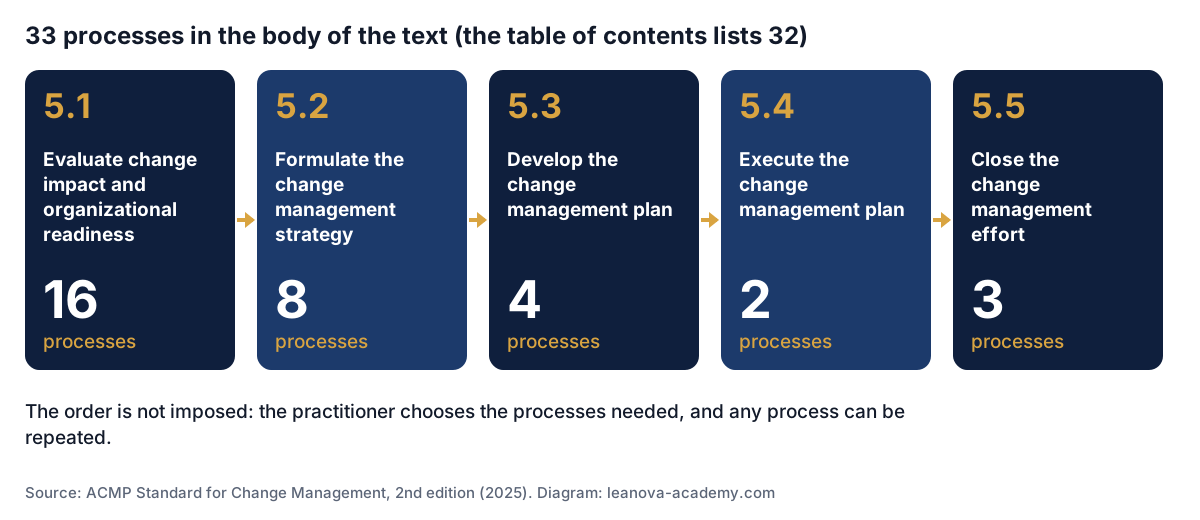
The counts add up to 33 processes in the body of the text. The table of contents lists one fewer for group 5.3, because it leaves out the integration process (5.3.2), a detail covered in the full checklist of processes and deliverables.
A short walk through each group:
- Evaluate. Sixteen processes, from defining the change and its reasons to the change impact assessment (5.1.8), the assessments of culture, capacity, readiness, communication needs and learning capabilities, and the change risk assessment (5.1.16). The results let the practitioner calibrate leaders' expectations and scale the effort. See the guide to group 5.1.
- Formulate. One strategy each for resources, communication, sponsorship, stakeholder engagement, readiness, learning and development, measurement and benefit realization, and sustainability. The strategy guide explains what each one decides.
- Develop. A comprehensive plan made of eight plans that mirror the eight strategies, its integration with the project plan, a review and approval with project leadership, and feedback mechanisms. The plan guide follows them.
- Execute. Carry out, manage and monitor the plans, and modify them when the evidence calls for it. The execution guide covers the signals to watch.
- Close. Evaluate the outcome against the objectives, run a lessons learned evaluation, then gain approval for closure, transfer ownership and release resources. Each of those steps is explained in our guide to closing the change management effort. The group also covers activities that reinforce the work, so closing is not simply the end of support for adoption.
How do you use the Standard without turning it into a recipe?
Treat it as a menu of well-established practices to select from, and let the nature of the change decide which ones you use. Section 4.3 asks for two analyses before scaling the effort: the variables of the change itself, such as technology, number of affected groups, degree of process change and speed, and an assessment of the organisation's culture and readiness.
A fictional example shows the difference. A regional insurer replaces its claims software in two offices of forty people each. The change lead does not run all 33 processes at full depth. She defines the change, runs a lightweight impact assessment, checks readiness with the two office managers, and writes a short communication and learning plan integrated into the project schedule. When the first office goes live and claims handlers revert to spreadsheets, she returns to the readiness and sponsorship processes before the second office starts, which the Standard explicitly allows. At closure she records what was learned and who owns the follow-up measures.
Three habits keep it useful:
- Start from the change, not from the list. Pick the processes that answer a real question on your project and note why you left others out.
- Write the output down. Each process comes with inputs and outputs, which the text says are indicative and not exhaustive, so adapt them to the documents your organisation already uses.
- Keep the Standard next to your method. It does not replace one, and its text says practitioners using a particular methodology will find commonalities with it. For how it relates to other models, see the methodologies comparison on this site.
How does the Standard relate to the CCMP exam?
The exam assesses knowledge and skills in line with the Standard, and the ACMP moved the exam to the second edition for sittings from 1 April 2026. The CCMP exam has 150 multiple-choice questions to answer in three hours, as the ACMP states on its exam preparation page.
The Standard does not publish an exam weighting, and neither does Appendix B: its nine subject groups are a way of reading the processes, not percentages of the test. Preparing with the Standard therefore means learning the vocabulary of section 3, the logic of the concepts in section 4 and the purpose of each process, then practising on situations. Appendix B and the 16 knowledge areas of Appendix A are put to use in the study guide built on the two appendices, and the ethics part of the volume is the subject of the guide to the five duties of the Code.
Candidates also need 21 hours of change management education aligned with the Standard. Leanova Academy's 21-hour self-paced CCMP course is one QEP route, and Leanova's blog gives a separate walkthrough of the five process groups. Whatever the provider, read the Standard itself once.
To check your own project against the 33 processes, use our free ACMP Standard project self-check: it scores each process group and lists the deliverables still missing.
Frequently asked questions
Is the ACMP Standard free to read?
The ACMP publishes it and describes how to obtain it on its Standard page, so check that page for current access terms. The document is copyrighted, which is why this site paraphrases it and links to the ACMP rather than copying passages.
Is the Standard a methodology?
No. It states that it draws on many existing methodologies and identifies generally accepted practice instead of copying one. It uses no mandatory wording and says that processes are generally used but not required.
Does the Standard apply to small changes?
Yes. Section 4.3 says any change within an organisation can be assessed on its variables and on the organisation's culture and readiness, from large funded projects to small changes outside normal project governance, and the effort is scaled to the result.
How many processes does the Standard have?
The body of the second edition describes 33 processes in five groups: 16, 8, 4, 2 and 3. Some also have sub-processes, such as the eight plans in 5.3.1 and the eight executions in 5.4.1.
Which edition does the CCMP exam use now?
The second edition, for exams taken from 1 April 2026, according to the ACMP's announcement of the new edition. Candidates should check the ACMP site for the latest schedule.
Was this article helpful?
Be the first to rate this article.
Summarise this article with:
Share: