ACMP subject groups for CCMP exam prep: a two-lens revision method
 · Published on
·Updated on ·7 min read
· Published on
·Updated on ·7 min read

Sommaire4 sections
What are the nine subject groups in Annex B?
Annex B of the ACMP Standard for Change Management, second edition (2025), re-sorts the same processes into nine subject groups, so you can follow one theme, such as communication, from the first group to the fifth.
This site follows Leanova Academy, an official ACMP® QEP™, and this guide shows how to revise for the CCMP using two lenses: the five process groups of section 5, and the nine subject groups of Annex B, checked against the sixteen knowledge areas of Annex A. The Standard itself comes from the ACMP; its Standard page is the authority. If you have not yet seen the structure of the document, read our overview of the ACMP Standard first.
The figures of Annex B come in two sets. The first five map the processes of each process group by subject group, and the remaining ones map each subject group across the five process groups. The annex states that this is only one possible view and that the arrows are not a required sequence. The nine subject groups are: Change Initiative Scope, Communication, Learning and Development, Stakeholder Management & Engagement, Resource Management, Leadership/Sponsorship Engagement, Measurement and Benefit Realization, Risk Management, and Sustainability.
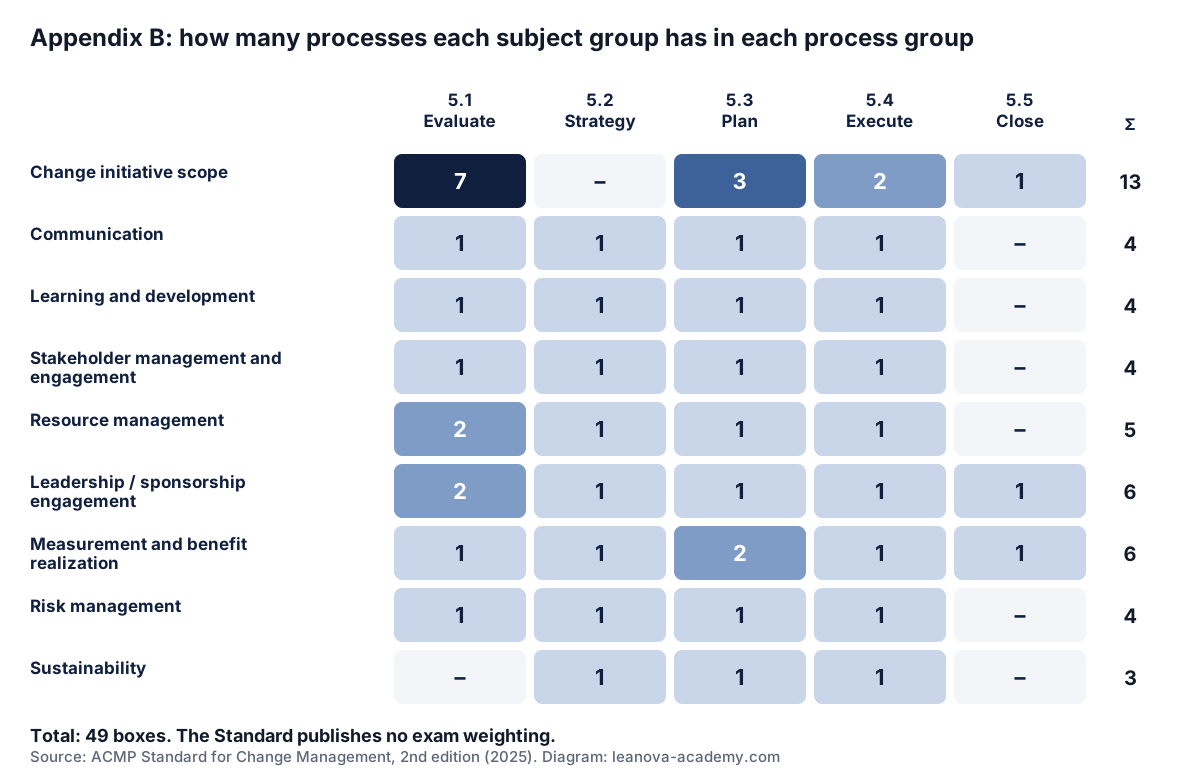
The heat map below shows how many boxes each subject group holds in each process group, and the table gives the same counts as numbers. We counted them from the figures of the annex.
| Subject group | 5.1 | 5.2 | 5.3 | 5.4 | 5.5 | Boxes |
|---|---|---|---|---|---|---|
| Change Initiative Scope | 7 | 0 | 3 | 2 | 1 | 13 |
| Communication | 1 | 1 | 1 | 1 | 0 | 4 |
| Learning and Development | 1 | 1 | 1 | 1 | 0 | 4 |
| Stakeholder Management & Engagement | 1 | 1 | 1 | 1 | 0 | 4 |
| Resource Management | 2 | 1 | 1 | 1 | 0 | 5 |
| Leadership/Sponsorship Engagement | 2 | 1 | 1 | 1 | 1 | 6 |
| Measurement and Benefit Realization | 1 | 1 | 2 | 1 | 1 | 6 |
| Risk Management | 1 | 1 | 1 | 1 | 0 | 4 |
| Sustainability | 0 | 1 | 1 | 1 | 0 | 3 |
| Total | 16 | 8 | 12 | 10 | 3 | 49 |
Three readings stand out. Change Initiative Scope is by far the heaviest subject group, with 13 boxes, and seven of them sit in group 5.1. Sustainability is the lightest, with 3 boxes, and appears only from the strategy group onward. And the readiness strategy and plans (5.2.5, 5.3.1.5, 5.4.1.5) are filed under Risk Management in the annex, even though the readiness assessment itself (5.1.13) is filed under Change Initiative Scope.
What do the 16 knowledge areas of Annex A add?
Annex A lists sixteen knowledge and skill areas that the ACMP calls unique and critical to change management, and it marks the boundary of what its certification covers.
The annex describes itself as the boundary conditions for the ACMP’s certification programs. It also says what falls outside. The ACMP does not certify how effective a particular person is as a change manager, and it will not develop standards and certification for general leadership, cross-cultural competence, interpersonal skills or consultative skills. It also leaves out the technical disciplines that create the change itself, such as strategy development, process design, organizational design, job role design and system development, and it treats project management as a complementary discipline with its own certifications. For a candidate, this is a useful limit: you revise what the annex lists, not everything that makes a good change leader.
The table pairs each knowledge area with the Annex B subject group that comes closest and the parts of the Standard worth rereading. That pairing is our own reading, made to help revision; the ACMP does not publish such a mapping in the Standard.
| Annex A knowledge area | Nearest Annex B subject group | Where to revise it (our reading) |
|---|---|---|
| The process of change | Change Initiative Scope | Section 4.1, plus 5.1.1 and 5.1.2 |
| Change management vocabulary | (terms, not a process) | Section 3, the 17 defined terms |
| Change management methodologies and tools | All groups | Section 5 introduction; read the neutrality statement |
| Relationship and integration of change management with other disciplines | Change Initiative Scope | Section 4.4, plus 5.3.2 and 5.3.3 |
| Adaptation of the approach to the change context and drivers | Change Initiative Scope | Section 4.3, plus 5.1.10 and 5.1.11 |
| Change management strategy, architecture, and planning | Most groups | Groups 5.2 and 5.3 |
| Change management team structures | Resource Management | 5.1.4, 5.2.1, 5.3.1.1 |
| Change leader/sponsor development | Leadership/Sponsorship Engagement | 5.1.6, 5.2.3, 5.3.1.3, 5.4.1.3 |
| Organizational and culture assessments | Change Initiative Scope; Resource Management | 5.1.8 and 5.1.11 to 5.1.13 |
| Stakeholder engagement | Stakeholder Management & Engagement | 5.1.7, 5.2.4, 5.3.1.4, 5.4.1.4 |
| Communications in support of the change process | Communication | 5.1.14, 5.2.2, 5.3.1.2, 5.4.1.2 |
| Training in support of the change process | Learning and Development | 5.1.15, 5.2.6, 5.3.1.6, 5.4.1.6 |
| Leading stakeholders through change | Stakeholder Management & Engagement | Section 4.5, plus 5.4.1.4 |
| Resistance management | Stakeholder Management & Engagement; Risk Management | 5.4.1.4 and 5.1.16 |
| Organizational change competency | Change Initiative Scope; Sustainability | 5.1.12, 5.2.8, 5.5.2 |
| Change performance measurement | Measurement and Benefit Realization | 5.1.5, 5.2.7, 5.3.4, 5.5.1 |
How do you revise for the CCMP with both lenses?
Learn the process groups first for the logic, use the subject groups second to follow themes, and check yourself against the sixteen knowledge areas last.
The exam is based on the second edition from 1 April 2026, and its published format is 150 multiple-choice questions in three hours; our article on the exam format sets out what the ACMP states. A workable sequence for a study plan, which you can also fit into a six-week plan, is below.
- Read section 5 group by group, noting for each process what goes in and what comes out. The 33-process checklist helps here.
- Pick one subject group per session and follow its thread through the five process groups. For Communication, that is 5.1.14, then 5.2.2, then 5.3.1.2, then 5.4.1.2.
- Take the sixteen knowledge areas and, for each, explain in two sentences what a practitioner would do and which document would show it.
- Write three short scenarios in which one thread fails, then say which earlier process should have prevented it.
A fictional example of step 2. A learner follows the Measurement and Benefit Realization thread: the goals and success criteria of 5.1.5 become the strategy in 5.2.7, which becomes the plan in 5.3.1.7, runs as reports in 5.4.1.7, is fed back through 5.3.4, and is tested in 5.5.1. Stated aloud, the thread shows that a missing success criterion early on makes the final evaluation impossible, which is a typical line of reasoning in scenario questions. In the same way, the group-by-group view in the article on the eight strategies shows how every strategy depends on earlier assessments.
For a structured route, Leanova’s self-paced CCMP exam prep course is a 21-hour QEP course at US$595 on 7 October 2026. Experienced practitioners deciding whether certification suits them can also read Leanova’s blog post on CCMP certification for seasoned practitioners. For what the second edition changed, see our note on the changes.
Frequently asked questions
Are the nine subject groups the exam domains?
The Standard does not say so. Annex B calls them subject groups and offers them as one view of the processes. No weighting is published in the document, so avoid any claim that one group is worth a fixed share of the exam.
Why does the annex count 49 boxes when there are 33 processes?
Because the figures show the eight plans (5.3.1.1 to 5.3.1.8) and the eight executions (5.4.1.1 to 5.4.1.8) as boxes of their own, in addition to their parent processes.
Does the ACMP certify the sixteen knowledge areas?
Annex A says these areas are within the scope of its recognition and certification programs. It also lists areas that fall outside, such as general leadership and project management.
Do I need to memorise the figures of Annex B?
Memorising layouts is of little use. It is better to understand why a process appears in a subject group and how the thread links to the others. The Code of Ethics in Part II is a separate section to study on its own.
Was this article helpful?
Be the first to rate this article.
Summarise this article with:
Share: