Leanova CCMP course certificate: proof of your 21 hours, checkable online
 · Published on
·Updated on ·8 min read
· Published on
·Updated on ·8 min read
Sommaire8 sections
This site follows Leanova Academy, an official ACMP® QEP™, and this article looks at the one document the 21-hour CCMP® course ends with: the Leanova Academy Certificate of Completion. It covers what the certificate shows, how you earn it, how an employer can check it, and where it stops being useful.
What is the Leanova course certificate?
It is a Certificate of Completion issued by Leanova Academy to learners who finish the self-paced 21-hour CCMP course (QEP code Q000607) and pass its final exam.
The course is described on the self-paced CCMP course page, and the details in this article come from the course syllabus (May 2026 edition). The certificate documents training. It does not award a credential from the ACMP. Keep that distinction in mind, because it decides how you may use the document later. The wider difference between a course record and an exam-based credential is explained in certificate or certification in change management.
How do you earn it?
You must complete the whole course and then pass the final exam, which has 50 randomly drawn questions, a 70 percent pass mark, two attempts and a 90-minute limit.
Finishing the lessons is not enough on its own, and neither is the exam without the lessons. The platform tracks progress and scores both the module quizzes and the final exam automatically, with feedback. The syllabus presents the quizzes as formative: they exist to help you retain the material, and the final exam is the gate. Two attempts are included in the course, so a first failed try does not end the process.
Do not confuse this exam with the ACMP exam. The course exam belongs to Leanova and tests the course. The ACMP exam is separate: 150 multiple-choice questions in three hours, supervised by Kryterion, as described on the ACMP CCMP page. Our guide to the CCMP exam format and pass mark covers the ACMP side.
| Point | Leanova course exam | ACMP CCMP exam |
|---|---|---|
| Who sets it | Leanova Academy | ACMP |
| Questions | 50, drawn at random | 150, multiple choice |
| Time | 90 minutes | Three hours |
| Result | Certificate of Completion, LCeX-P™ badge | CCMP® credential |
ACMP figures are from the ACMP website as read on 7 October 2026. Leanova figures are from the syllabus.
What is printed on the certificate?
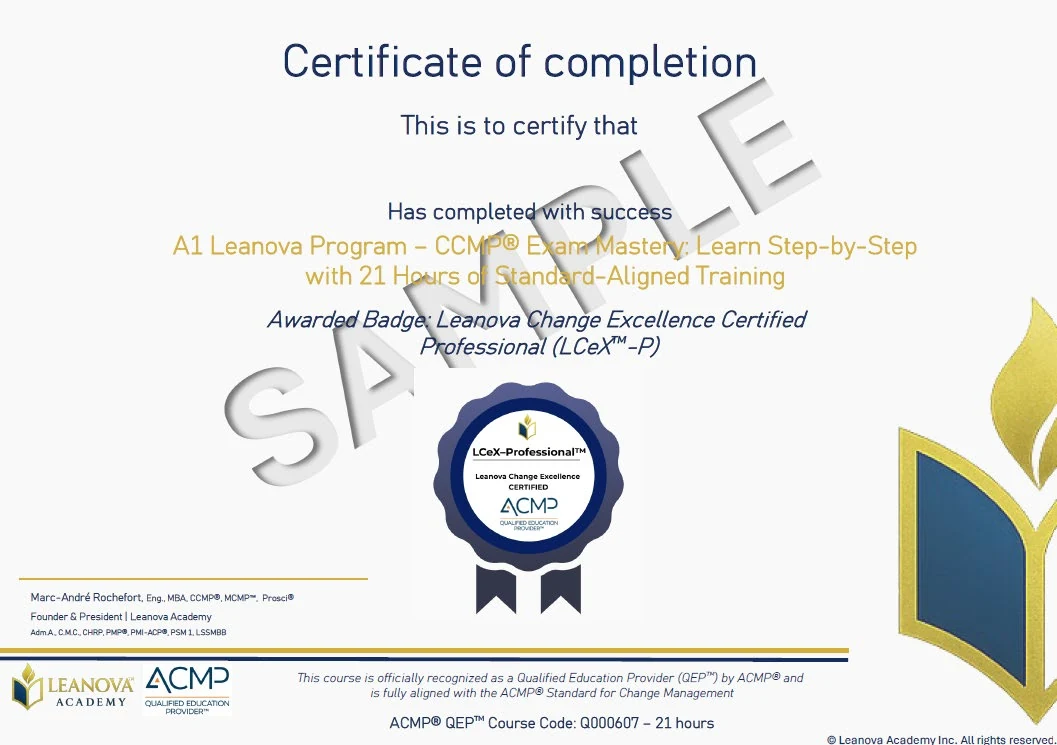
The certificate carries the course title, a unique certificate number, the date of issue, the instructor’s credentials, a statement of QEP recognition, and the code line “ACMP® QEP™ Course Code: Q000607 – 21 hours”.
In more detail, the syllabus lists these elements:
- the full title of the course, A1, Mastering CCMP® Exam, with its 21 hours of Standard-aligned training;
- a unique certificate number, which is what makes later verification possible;
- the date you received it;
- the instructor’s professional titles;
- a note that the ACMP recognises the course as a Qualified Education Provider course aligned with the Standard;
- the QEP code and the number of hours, which is the line an application reviewer will look for.
The syllabus reproduces a template of the certificate marked “SAMPLE”, so you can see the layout before you enrol.
How can someone verify it?
Through the digital badge: learners also receive a verified LCeX-Professional™ badge, issued through Certifier, which anyone can check online instantly.
The badge and the unique certificate number work together. An employer or a training manager who wants proof does not need to take a PDF at face value. They can check the badge online, and you can share it on LinkedIn or place it in your résumé. According to the syllabus, this traceability is meant to satisfy audit requirements from employers or professional bodies. If you are asked for evidence years later, the number and the badge are what you point to, so store both when they arrive.
You can also check the course itself. The QEP label means the ACMP qualified the course, and what the ACMP QEP label means explains how to look a course up before you pay.
What is the certificate good for?
Its main use is as proof of the 21 hours of change management training the ACMP asks for in a CCMP application.
The ACMP lists, on its eligibility page, 21 hours of training aligned with the Standard completed in the past seven years, next to the experience hours. The rule and its exceptions are described in the CCMP 21-hour training requirement, and the sequence of steps in the CCMP application process. The application itself stays with the ACMP, and so does the decision.
Beyond the application, the certificate has three everyday uses:
- Employer records. A training manager can file it as evidence of a completed, recognised course.
- Visible profile. The badge can sit on LinkedIn and in a résumé, with a link anyone can follow.
- Post-nominal. Graduates may add the LCeX-P™ mention after their name.
Practitioners who already have years of experience sometimes ask where this fits in their path. Leanova addresses that situation in its blog post about certification for experienced practitioners.
What does the certificate not prove?
It does not prove that you hold the CCMP®, and it does not guarantee that you will pass the ACMP exam or be accepted for the credential.
The CCMP® is delivered by the ACMP after an application and an exam. LCeX-Professional™ and the LCeX-P™ post-nominal are designations created by Leanova Academy, a training provider, rather than by an independent body. Do not write “CCMP” after your name because you hold the certificate. Write what is true: a completed 21-hour QEP course, with the date. Before opening the course, learners also sign an electronic disclaimer that separates Leanova’s training from the ACMP certification, which tells you how seriously the distinction is taken.
What do you study to reach it?
You work through 45 modules, each built on the same four-part Job Instruction sheet, around a fictional case called VitaNova Health.
The course follows the five process groups of the ACMP Standard for Change Management, second edition (2025), from 5.1, evaluating change impact and organisational readiness, to 5.5, closing the change management effort. The modules are also tied to the nine core competency areas of the Standard. Each module’s sheet, inspired by the Training Within Industry method, tells you what to do, how to do it, why it matters, and what deliverable you produce.
In the case, you play the change leader of VitaNova Health, an invented organisation, and each module produces one downloadable deliverable. That makes 45 deliverables by the end, a portfolio of working documents. Every module also flags three frequent mistakes and gives three tips, and three quiz questions per module add up to 135 in all. The code of ethics of the ACMP is introduced along the way.
The self-paced course gives 12 months of access and was listed at US$595 on 7 October 2026. You can see the full outline on the course page at Leanova.
Download the course syllabus (PDF, 8 pages): the Leanova syllabus, May 2026 edition, laid out by leanova-academy.com.
Frequently asked questions
Is the Leanova certificate the same as the CCMP?
No. The certificate shows that you completed a 21-hour QEP course and passed its exam. The CCMP® is awarded by the ACMP after an application and the ACMP exam.
How many attempts do I get at the course exam?
Two attempts are included. The exam has 50 questions, a 70 percent pass mark and a 90-minute limit, according to the syllabus.
Can an employer verify my certificate?
Yes. The certificate has a unique number, and the LCeX-Professional™ digital badge issued through Certifier can be checked online.
Does the certificate count towards my CCMP application?
It documents the 21 hours of training the ACMP requires. The ACMP reviews the whole application, including experience hours, and decides. Read the ACMP’s page on the Standard for the framework the training is aligned with.
Which hours does the certificate cover?
It covers the 21 hours of the self-paced course, QEP code Q000607. A different course, such as the 10-hour MCMP™ course, has its own code and hours.
Before choosing a course, you can compare options in the review of the best CCMP exam prep courses, and the background of the provider is set out in the article on Leanova Academy and its ACMP QEP status.
Was this article helpful?
Be the first to rate this article.
Summarise this article with:
Share: